

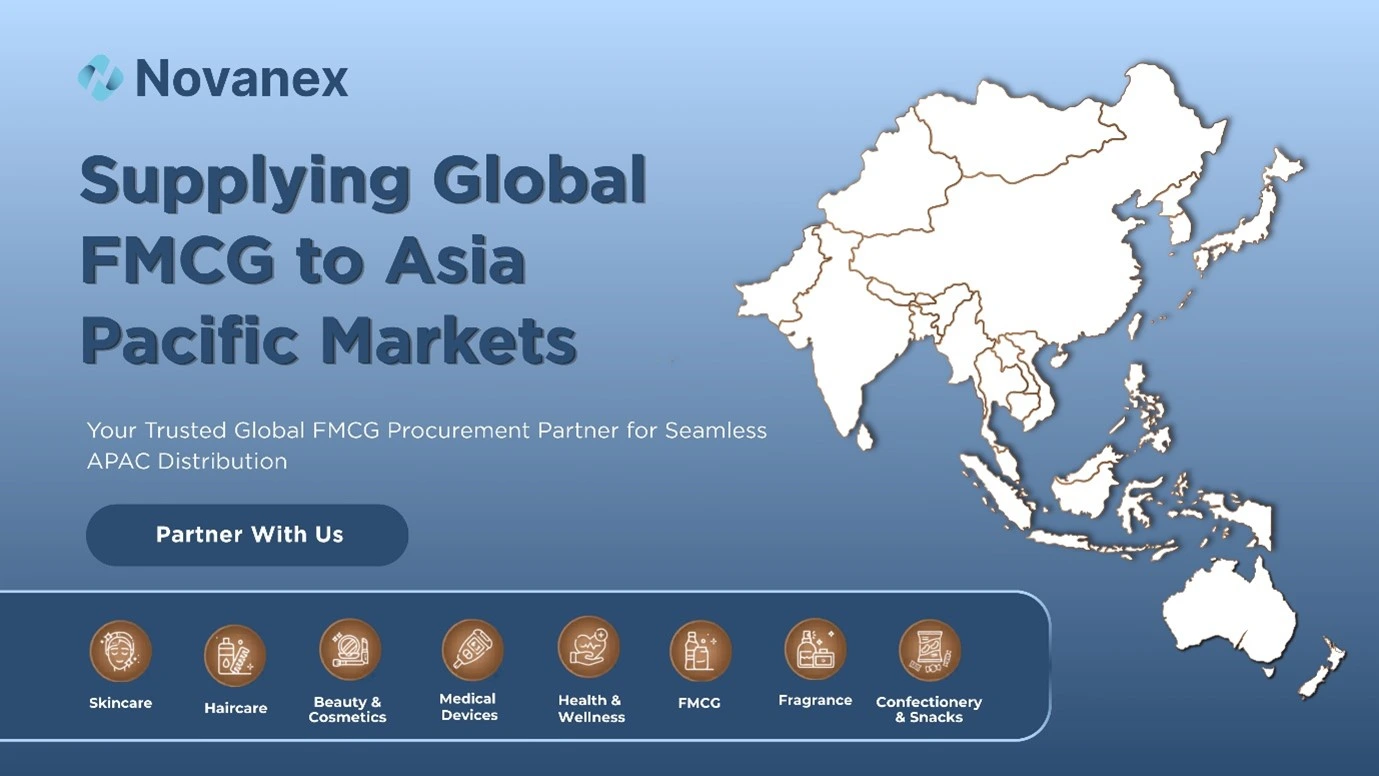
Supplying Global FMCG to Asia Pacific: choosing a Procurement partner | FMCG wholesale suppliers Asia Pacific | Global FMCG procurement partner
The Asia Pacific (APAC) region represents one of the most dynamic, high growth markets in the world. With a combined population exceeding 4.3 billion, rapidly expanding middle class segments, the demand for Global brands across FMCG categories from Food & Beverage to Health & Beauty, Household, Pet Care, Baby, and OTC is rising exponentially. Many companies are rising to this increased demand and are sourcing products on global basis through a FMCG sourcing company and FMCG procurement services.
The region spans mature markets (Australia, Singapore, Japan) and rapidly evolving ones (Indonesia, Philippines, Vietnam), each with different regulators, rules, and route to market realities. That mix is what makes Asia Pacific so attractive and so unforgiving if you approach it with a one size fits all playbook. The winners are not just those with the longest product list; they’re the ones with regulatory fluency, trade agreement literacy, disciplined landed cost control, and resilient logistics. – [lpi.worldbank.org]
This guide distils what it actually takes to supply Food & Beverage, Health & Beauty/Personal Care, Household/Cleaning, Pet Care, Baby, and OTC/Pharmacy adjacent products across APAC with consistency. Importantly it lays out the criteria importers and local suppliers should use when selecting their Global FMCG procurement partner and FMCG distributors Asia Pacific.
1. All partners must treat Asia Pac as separate countries – the strategy starts with Market Heterogeneity, Not “APAC” as One Block
Asia Pacific is not a single market, it is a collection of distinct, often drastically different markets, each with its own regulations, cultural expectations, and commercial structures. High quality providers, including the best FMCG wholesale supplier for Asia Pacific market, recognise this and have an understanding and appreciation of differences in market demand, regulations and cultures and processes. All good providers will have country level knowledge and experience.
2. Use a Procurement partner who understands the Regulatory mosaic, Category by Category, Country by Country
Each country and category will have its own rules and regulations surrounding the importation, supply and distribution of products.
Failure to meet even one element can result in shipping delays, product rejection, or fines creating cost and risk for both supplier and customer working with FMCG wholesale suppliers Asia Pacific.
Experience matters enormously. A partner who understands market specific expectations, especially an experienced FMCG sourcing company, can streamline approvals, reduce friction, and protect supply timelines.
Cosmetics / Personal Care (Health & Beauty)
- China (CSAR) re set the regime in 2021: new classifications (special vs. general), safety assessments, efficacy claims substantiation, and a China Responsible Person model. Many general cosmetics can now bypass animal testing under defined conditions but dossiers and safety evidence are non negotiable. [mdpi.com], [cosmetic.c…linked.com], [coptis.com]
- Singapore (HSA) aligns to the ASEAN Cosmetic Directive. Market entry requires product notification (not pre approval), Annex ingredient compliance, and compliant labelling; firms bear post market responsibility. [hsa.gov.sg], [sso.agc.gov.sg]
- Indonesia (BPOM) requires formal registration before sale—foreign brands must appoint a local licence holder and align ingredients to national lists; documentation and e BPOM submission precede approval. [productreg…onesia.com], [indonesia….ncorp.asia]
Food & Beverage
- Australia/New Zealand enforce the FSANZ Food Standards Code: general labelling (Ch.1), category specific requirements (Ch.2), allergen declarations, country of origin, and legibility rules—non compliance is enforced at state level. [foodstandards.gov.au], [legislation.gov.au]
- China requires GACC registration for many foreign food manufacturers and tight labelling controls (beyond the scope here but a must check for exporters). [worldbank.org]
- Halal: Malaysia (JAKIM) certification is highly recognised across Muslim markets; for Indonesia, mandatory halal is now staged—core food categories for medium/large businesses since Oct 18, 2024, with imported products facing a hard deadline of Oct 17–18, 2026 (final ministerial framing) as BPJPH operationalises the regime. Early preparation is essential. [bpjph.halal.go.id], [en.antaranews.com]
OTC / Pharmacy Adjacent
- Australia (TGA): non prescription medicines require ARTG listing/registration with dossier pathways (N1–N5) under ARGOM, GMP proof, and labelled PI/CMI where applicable. This is a regulated, time bound path—plan upstream. [tga.gov.au], [tga.gov.au]
- Singapore/Philippines: borderline claims may reclassify products (cosmetic vs. therapeutic). In the Philippines, importers need an LTO first, then product level notification/registration depending on classification. [fda.gov.ph], [philippine…ncorp.asia]
Experience matters enormously. A partner who understands market specific expectations can streamline approvals, reduce friction, and protect supply timelines
3. Partners need to have Logistics and Supply Chain flexibility to cope with volatility
Supply chains into Asia Pacific require resilience and flexibility. The region’s geography, infrastructure gaps, and long shipping distances from European or North American manufacturing bases introduce unavoidable complexity for FMCG procurement services providers.
Key challenges include:
- Shipping lead times that can stretch from 20 to 60+ days, depending on destination
- Port congestion, especially during peak seasons
- Complex customs clearance processes
- Variable infrastructure quality, particularly in emerging markets
- Fluctuating transportation and freight costs
- Seasonal disruptions, such as monsoons or typhoon affected routes
4. An effective procurement partner always provides Global sourcing to identify the most effective price
Pricing is a critical success factor in APAC, where competition both domestic and international is intense, especially among FMCG distributors Asia Pacific.
The main pricing challenges include:
- Currency volatility impacting landed costs
- Import duties and taxes that differ country by country
- Freight cost instability, especially for long distance shipping
- Competitive pressures from regional manufacturers who operate with lower cost bases
To maintain competitiveness, suppliers need the ability to:
- Optimise sourcing
- Consolidate shipments
- Leverage global buying power
- Maintain flexible logistics models
- Forecast and adjust pricing ahead of cost movement
Novanex’s ability to negotiate strong product and freight terms through global procurement channels positions it as a Global FMCG procurement partner allowing customers to maintain market ready price points without sacrificing quality.
5. Procurement partners should understand and respond rapidly to demand fluctuations
APAC markets can move quickly and unpredictably. Seasonality, promotional dynamics, and economic fluctuations can lead to sudden shifts in demand, making forecasting and inventory planning far more complex than in stable, mature regions for any FMCG wholesale suppliers Asia Pacific.
Factors driving volatility include:
- Rapid shifts in consumer trends
- Heavy reliance on promotions in some markets
- Uneven economic growth across the region
- Varying impact of global events across different countries
- Retailers’ preference for just in time inventory models
6. Local relationships are vital
While product availability and pricing are fundamental, lasting success in APAC depends equally on relationships. Strong local partnerships are essential for navigating market realities, especially for a best FMCG wholesale supplier for Asia Pacific market.
Challenges include:
- Understanding cultural expectations
- Building trust with distributors and retailers
- Managing multi layered supply relationships
- Ensuring communication across time zones and languages
- Aligning expectations across countries
Conclusion:
An effective procurement partner for Global brand supply to APAC countries requires demonstrated Experience, Adaptability, and Strong Networks typical of a leading Global FMCG procurement partner.
Supplying into Asia Pacific presents a unique combination of opportunity and complexity. The markets are rich with potential, but the barriers regulatory, logistical, economic, and cultural require suppliers to operate with sophistication and precision, supported by strong FMCG procurement services.
This approach enables us to support customers across APAC with confidence, consistency, and commercial value as a trusted FMCG sourcing company and partner to FMCG distributors Asia Pacific.
For businesses looking to enter or expand their Global supply into APAC, choosing the best FMCG wholesale supplier for Asia Pacific market who understands these challenges and knows how to overcome them is the key to lasting success.
For more information about Novanex and our services to the APAC region
please contact us on [email protected]